
Copper Is Not Short. Deliverable Copper Is.
Record copper prices next to record US inventories: why mobility, tariffs and gold by-product credits now set the price, and what buyers should check.
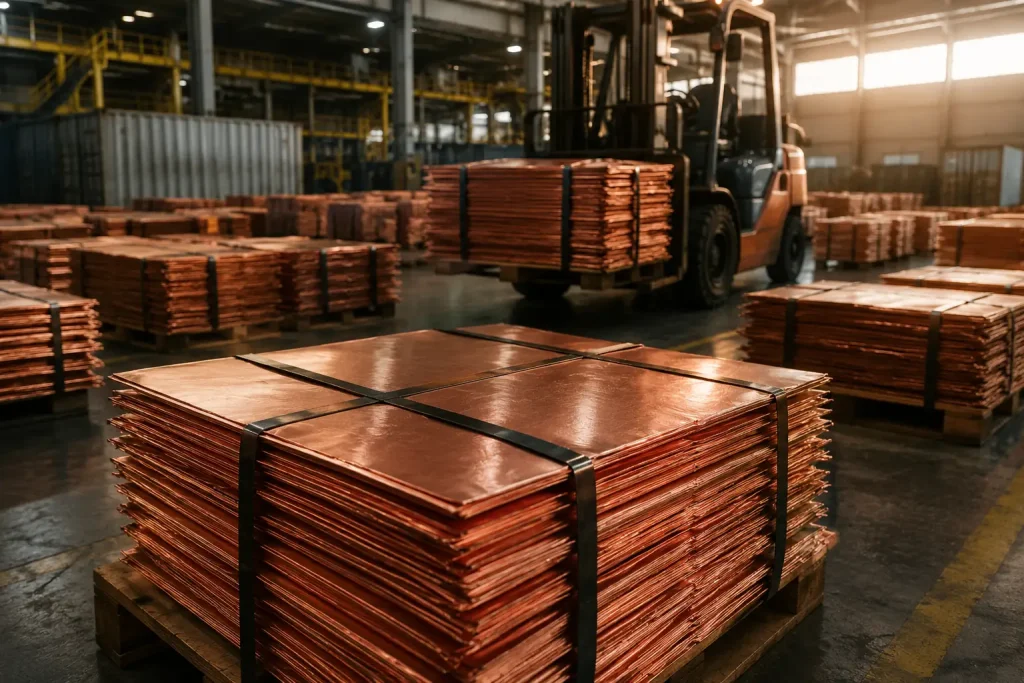
Copper has spent the summer sending two signals that should not coexist. Prices held near record levels, and at the same time a record 652,200 tonnes of refined copper sat in COMEX warehouses in the United States, up from roughly 80,000 tonnes in February 2025. A market cannot be short and oversupplied at once — unless the thing being priced is not copper in general, but copper in the right place, in the right form, with the right paperwork. That is the market we are actually trading in 2026. This article explains the mechanism, the numbers, and what they mean for anyone buying cathode or moving concentrate this year.
Mine production explains less than the textbooks say
The supply news this year was dramatic. The mud rush at Grasberg in September 2025 put the world’s second-largest copper mine under force majeure and cut its 2026 output plan; Benchmark Mineral Intelligence expects the loss to push the refined market into deficit this year. Cobre Panama is inching back one court decision at a time. These are big numbers, and they matter.
Yet look at what actually moved the price over the past twelve months. The sharpest swings did not follow mine reports. They followed announcements from Washington. A tariff decision moved copper more in a day than Grasberg’s force majeure did in a week. Pricing power has moved. The rules deciding where metal can go next now weigh more than anything happening in the pit.
The tariff experiment: one metal, two prices
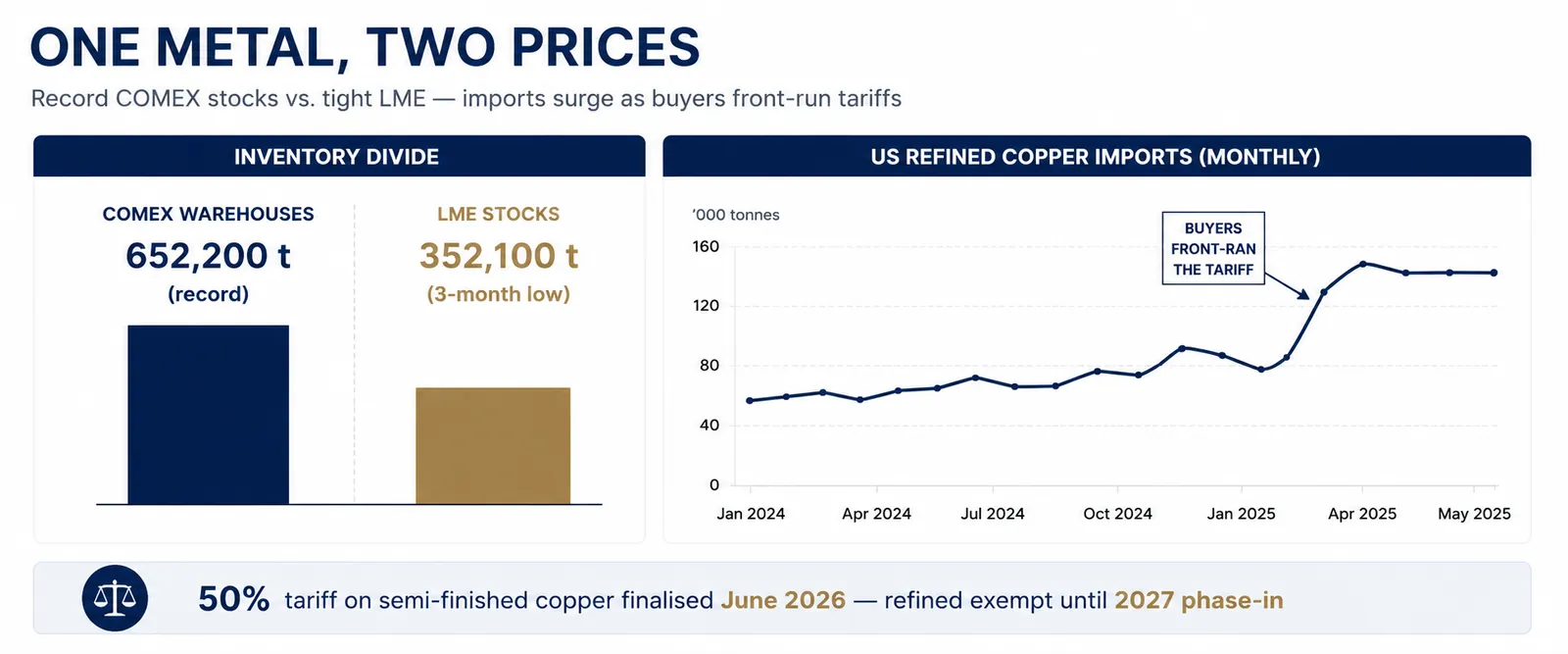
The United States finalised a 50% tariff on semi-finished copper products at the end of June, with refined copper temporarily exempt and a phase-in scheduled from 2027. The market did not wait. American buyers front-ran the rules for over a year: US refined imports averaged around 140,000 tonnes a month from January 2025, nearly double the 2024 pace. The metal went in, and it stayed in.
The result is the strangest inventory split the copper market has seen. A record pile in COMEX warehouses. LME stocks drained to a three-month low. And a premium between the two exchanges that rises and falls on every hint from Washington. An electrical fabricator in Ohio and one in Hamburg can look at the same tonne of Grade A cathode and see two different prices. The difference is not grade, brand or purity. It is whether the metal is on the right side of a border. Mobility has become a priced attribute of copper, the way purity always was.
Concentrate has a mobility problem of its own
The same logic runs upstream, in quieter ways. Indonesia ties concentrate export permits to domestic smelting progress, so a change in Jakarta’s policy calendar moves tonnes without any mine producing less. Copper from the DRC and Zambia crosses two thousand kilometres of road and rail before it reaches a port, and every congestion episode on those corridors is a supply cut that appears in no production statistic. Panama held a functioning mine offline for two years on legal grounds while its stockpiles waited. In each case the ore exists. What changes is whether it can legally and physically reach a buyer. When traders talk about tightness in 2026, this is usually what they mean.
The gold inside the concentrate
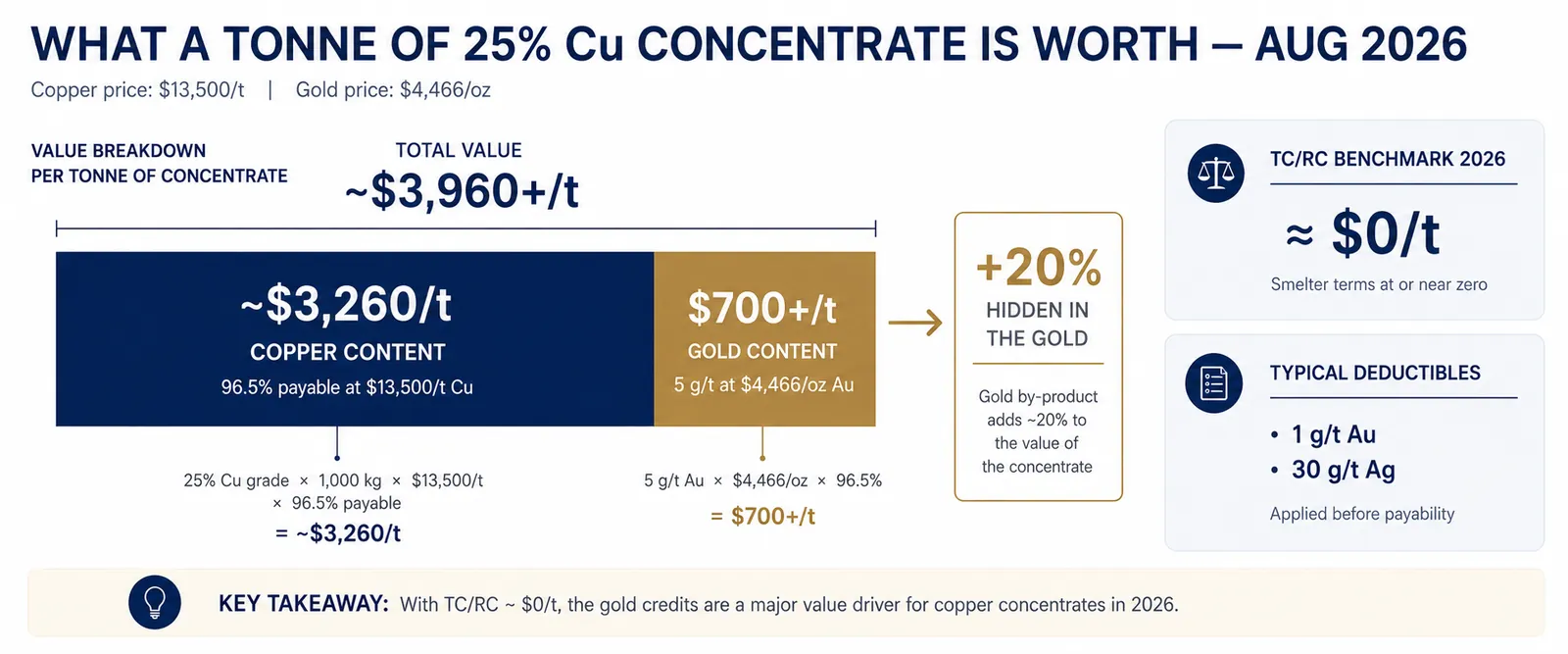
There is a second thing the headline copper price hides, and it has become impossible to ignore this year: what else is in the concentrate. With the 2026 TC/RC benchmark settling around zero and spot terms negative for months, smelters effectively process copper for free. They survive on everything else in the contract: payable metal clauses, by-product credits for gold and silver, and sulphuric acid sales. As one market commentary put it this summer, smelters are getting paid in gold and acid.
Run the numbers at today’s prices and you see why. A copper concentrate carrying 5 g/t of gold holds a bit over $700 per tonne of gold value at $4,466/oz, before payability. Set that against the copper itself: a 25% Cu concentrate at $13,500 copper, on a typical 96.5% payable, is worth about $3,260 per tonne for its copper content. The gold adds more than a fifth on top. Two concentrates with identical copper grades can differ by hundreds of dollars a tonne, and the difference never appears in a copper price chart.
Value in one tonne of 25% Cu concentrate | At August 2026 prices |
Copper content (25% Cu, 96.5% payable, $13,500/t Cu) | ~$3,260 |
Gold at 5 g/t ($4,466/oz, before payability) | ~$700+ |
Gold uplift on copper value | More than one fifth |
Typical gold deductible / silver deductible | ~1 g/t Au · ~30 g/t Ag |
The contract mechanics decide who captures that value. Typical terms pay gold above a deductible of around 1 g/t and silver above roughly 30 g/t, at payabilities that are themselves negotiable. A seller who ships without a full precious-metals assay hands the credit to the smelter. A buyer who ignores penalty elements — arsenic, bismuth, mercury — meets them again on the final invoice. With treatment charges at zero, the by-product schedule stopped being fine print. Deals are won and lost there now.
What this means if you buy cathode or trade concentrate
For cathode buyers, the practical rules have changed. Check which exchange your price basis actually reflects, because LME and COMEX are no longer interchangeable. Ask where the metal sits before you ask what it costs. Keep origin optionality: non-sanctioned, non-tariff-exposed material now carries a premium for a reason, and the 2027 phase-in questions make origin flexibility worth paying for. For concentrate, assay everything, negotiate the payables with the same energy as the TC, and treat a gold-bearing concentrate as a different product with a different buyer list — because at current gold prices, it is.
Au Club’s offer
Au Club supplies LME Grade A copper cathode (99.99% Cu min) from non-sanctioned origins with full documentation, SGS inspection basis and clear Incoterms, shipped through Jebel Ali and GCC ports. On the concentrate side, we work with transparent payable terms, full assays including precious metals, and benchmark-referenced pricing. If you are weighing origins, exchanges or by-product clauses this quarter, talk to the desk about pricing, lead times and Incoterms for your volume.
Looking ahead
Three things to watch into 2027. First, whether refined copper loses its tariff exemption when the phase-in starts, which would redraw the COMEX-LME relationship again. Second, how fast Grasberg actually recovers, because Benchmark’s deficit call for 2026 rests on it staying slow. Third, the TC/RC talks for 2027: another year at zero would push even more of the concentrate market’s economics into by-product clauses. None of these depend on how much copper gets mined. All of them depend on where it can go and what travels with it.
FAQs
Why are copper prices high if inventories are at records?
Because the record is in one country. COMEX warehouses hold 652,200 tonnes while LME stocks sit at a three-month low of 352,100 tonnes. The metal is abundant where tariffs pulled it and scarce where the rest of the world buys. Price follows the scarce side.
What is the COMEX-LME copper premium?
It is the gap between the US futures price and the LME price for near-identical metal. It exists because tariffs and the threat of tariffs make it costly or risky to move copper into or out of the US, so the two markets price the same metal differently. Its size tracks trade policy news.
Do gold credits really change copper concentrate pricing?
Yes, and more than most sellers expect. At $4,466/oz, a concentrate with 5 g/t gold carries over $700/t of gross gold value, against roughly $3,260/t of copper value in a typical 25% concentrate. Contracts usually pay gold above a deductible near 1 g/t, at negotiated payability.
Does the US 50% tariff apply to copper cathode?
As of August 2026, the 50% tariff finalised in June covers semi-finished copper products, with refined copper temporarily exempt and a phase-in scheduled from 2027. The exemption is the single most watched line in the copper market; confirm current status before booking US-bound material.
What should I check in a concentrate contract beyond the TC/RC?
Payable percentages for copper, gold and silver, the deductibles, penalty element thresholds (arsenic, bismuth, mercury, fluorine), the quotation period, and the assay and umpire procedure. With treatment charges at zero, these clauses carry the economics.
About Au Club
Au Club is a Dubai-based commodity trading company supplying marine fuel, metals, and minerals worldwide. We trade LME Grade A copper cathode from non-sanctioned origins, with SGS inspection basis, full documentation and benchmark-referenced pricing, FOB UAE or CFR/CIF destination. To enquire about availability and pricing, contact our trading desk.
Related reading: Sulphuric Acid Used to Be a By-Product. Now It Prices Copper, Nickel, Uranium and Food.
Sources & further reading
- Fastmarkets — Grasberg force majeure and 2026 output cut
- Benchmark Mineral Intelligence — refined copper deficit analysis, 2026
- Goldman Sachs copper forecasts, as reported June 2026 (year-end $13,735/t)
- Exchange inventory data — COMEX 652,200 t and LME 352,100 t
- Gold spot $4,466/oz — Forbes Advisor, 20 August 2026
- Mining.com — Freeport statements on the Grasberg restart