
Sulphuric Acid Used to Be a By-Product. Now It Prices Copper, Nickel, Uranium and Food.
The 2026 sulphuric acid crisis: the Hormuz sulphur shock, China's export ban, and what it does to copper, fertiliser, nickel and uranium producers and prices.
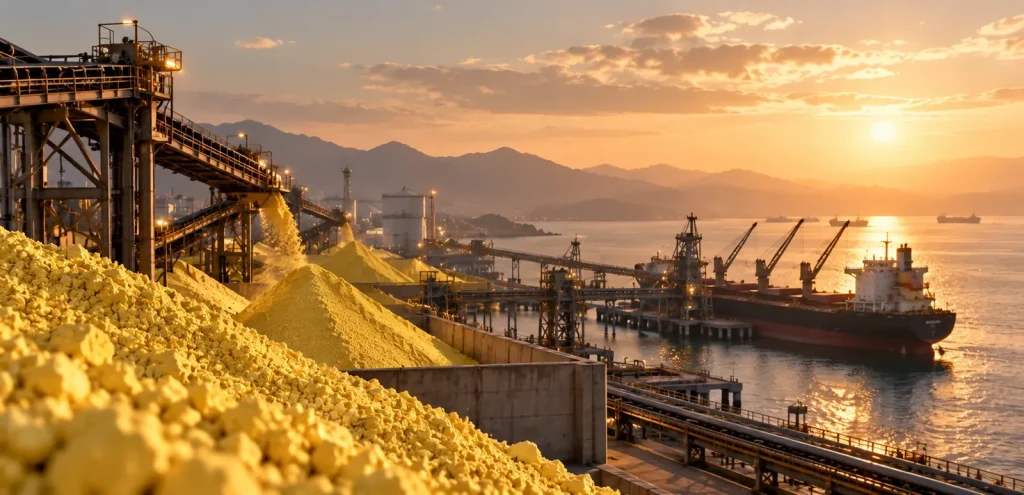
Sulphuric acid has never had a price chart anyone cared about. It is what smelters and gas plants are forced to make, and for most of the last decade the problem was finding someone to take it away. That ended on 28 February, when the Strait of Hormuz closed and roughly half of the world’s seaborne sulphur stopped moving. Six weeks later China, the largest acid exporter on earth, said it would stop shipping, and on 12 September Russia banned acid exports of its own through the end of the year. Sulphur has gone from about $100 a tonne to $890 FOB Qatar. Acid that cost Chilean leach operations $190 a tonne in February traded at $380 by April and above $1,000 delivered on the DRC Copperbelt. Copper gets the headlines, but copper is the smaller part of this. The same chemical sits under phosphate fertiliser, battery-grade nickel and Kazakh uranium, and in three of those four it is a bigger share of cost than it is in copper.
Data as at 19 September 2026. Prices and policy status are stated as of that date, with sources listed below.
Why a by-product cannot respond to price
Most of the world’s sulphur is recovered from sour gas and heavy crude. Nobody drills a well for it. The Gulf produces about a quarter of global output and half of what moves by sea, nearly all of it loading inside Hormuz, and when the strait shut S&P Global put 47% of seaborne sulphur exports behind it. By the April peak Kpler counted more than 600,000 tonnes stranded on ships in the Gulf. (For how shipping behaves when a chokepoint closes, see our Red Sea rerouting analysis — sulphur is now running the same playbook in bulk form.)
Acid is the same story one step down. China makes about a third of the world’s sulphuric acid, partly by burning imported sulphur and partly as an unavoidable by-product of copper and zinc smelting. It exports only about 4% of production, but that 4% was 4.6 million tonnes in 2025 and it fed Chile, Indonesia, Morocco and Saudi Arabia. Beijing cut the January to April quota to about 700,000 tonnes, then announced on 10 April that exports would stop from May to protect its own phosphate plants. Chile’s imports from China went from 151,268 tonnes in March 2025 to zero in March 2026.
Russia has now done the same thing. Moscow restricted technical sulphur exports in late 2025 and has extended that ban through the end of 2026, and on 12 September Prime Minister Mishustin signed a decree halting sulphuric acid exports as well, effective ten days after publication and running to 31 December, with narrow carve-outs for transit and for shipments cleared by the prime minister’s office. The stated reason was the same as Beijing’s: keep the acid for domestic fertiliser producers and industry. Three of the biggest suppliers to the seaborne sulphur and acid market have now each decided, separately, that their own farmers come first.
That is what makes this different from a normal squeeze. Sulphur at $890 does not bring one extra tonne to market, because sulphur output is set by how much gas and oil gets processed, and acid output by how many smelters are running. Price rations demand. It cannot create supply. Kazatomprom put it plainly in its own filings: sulphuric acid is not manufactured to order, it is predominantly a by-product of smelting.
The price path, February to September
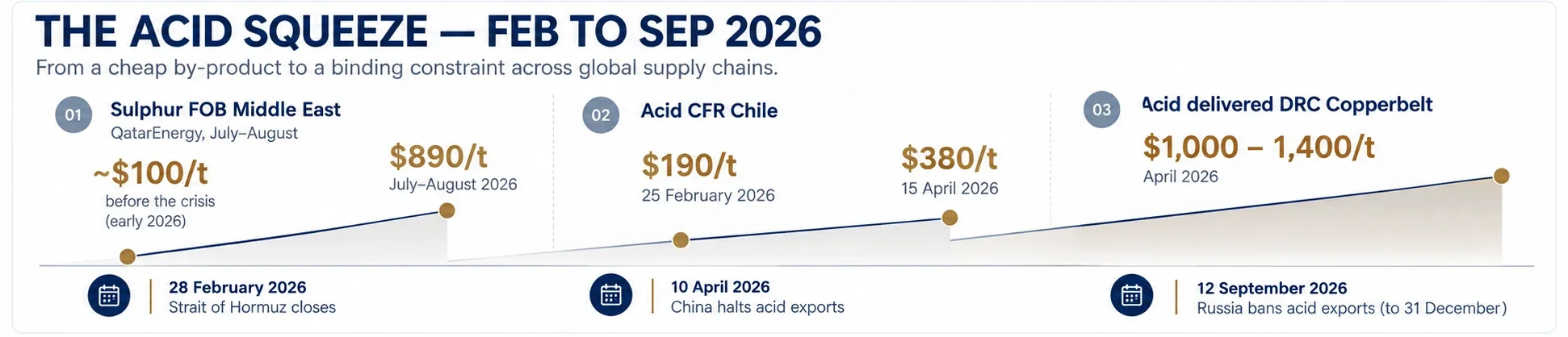
Middle East sulphur was around $100 a tonne FOB going into the war, by Mosaic’s own account. It set an all-time high of $815 to $820 FOB on 28 May, with cargoes into Brazil at $1,200 CFR, and QatarEnergy has posted $890 for July and August. Acid into Mejillones doubled from $190 on 25 February to $380 by 15 April, delivered acid on the DRC Copperbelt was quoted at $1,000 to $1,400 the same month, and inside China the SMM smelting acid index went from 890 yuan in January to 1,660 by late April.
None of it has unwound. Bloomberg reported a first Chinese acid cargo leaving port on 8 September, and Iran and Oman agreed a narrow temporary lane on 26 August. But no sulphur cargo has been confirmed exiting Hormuz since 18 July and transits were running at eight a day against a normal 85 on 13 September. Robert Friedland, whose Kamoa-Kakula smelter sells acid into the Copperbelt, said on 12 September that high-strength acid there was trading above $1,000 a tonne and had more than doubled in three months. Fastmarkets has launched a CFR Chile acid assessment, which tells you something on its own: nobody needed a published price for this until now.
Where the acid actually goes
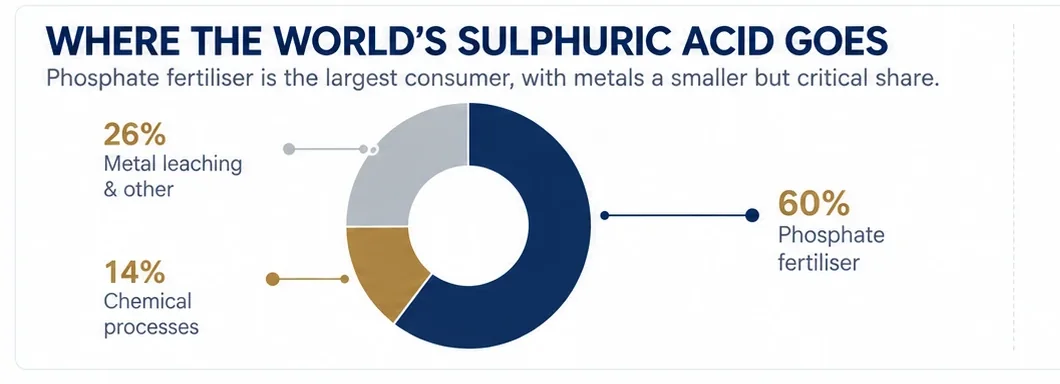
Before the sector detail, the proportions are worth fixing in your head, because most of the coverage has them backwards. Phosphate fertiliser is about 60% of world sulphuric acid consumption, per S&P Global’s chemical economics work. Chemical processes take roughly another 14%. Metal leaching, which is where copper, nickel and uranium sit, is a much smaller share of the total. Copper dominates the reporting because copper has a daily price and a loud analyst community. It is not the biggest user and it is not the worst affected.
Sector | Acid or sulphur intensity | What has happened in 2026 |
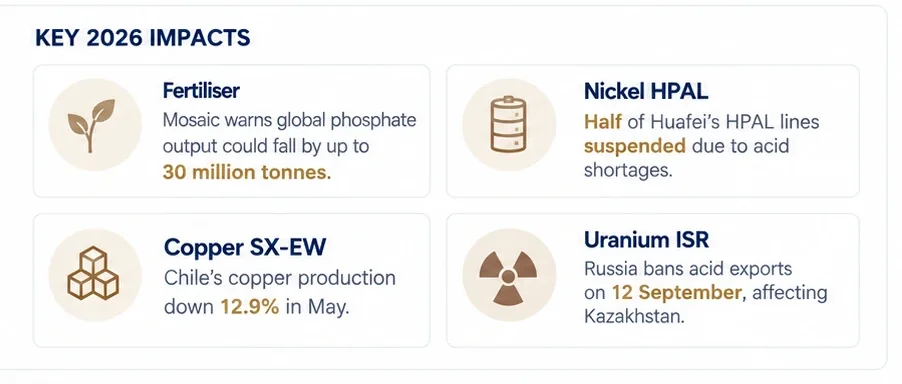
Phosphate fertiliser (~60% of acid demand) | 4 t sulphur per 10 t DAP or MAP | Mosaic idled Louisiana, ran Bartow near 40%, halted Catalao and Tapira in Brazil from 1 June, withdrew guidance on 11 May. Egypt’s EFIC stopped all three SSP plants |
Nickel and cobalt, HPAL route | ~10 t sulphur per t Ni in MHP, over half of cash cost | Huayou’s Huafei suspended about half its lines from 1 May. Indonesian MHP output in May ran about a third below the prior year |
Copper, SX-EW route (~15-20% of refined copper) | 3 to 22 t acid per t cathode | Chile’s leached fifth, roughly 1.1 Mt a year, exposed. Chilean May output down 12.9% year on year. DRC delivered acid $1,000 to $1,400 |
Uranium, Kazakh in-situ recovery | 1.2 to 1.5 Mt acid a year for Kazatomprom, more again for the rest of Kazakh mining | Was a cost problem. Russia’s 12 September export ban, running to 31 December, turns it into a fourth-quarter volume question, because Kazakhstan takes nearly all Russian acid exports |
Two things follow from that table. The sector with the least pricing leverage, fertiliser, is the one consuming the most acid, which is why Beijing protected its phosphate plants first and let its export customers absorb the loss. And the sectors where acid is the majority of cash cost, HPAL nickel above all, cut production fastest, because there was no version of the arithmetic that worked.
Copper: the fifth of Chile that leaches
Set the acid price against the copper price and the cuts explain themselves. A leach operation uses anywhere from 3 tonnes of acid per tonne of cathode on clean high-grade oxide to 22 tonnes on very low-grade ore. Two ordinary cases:
Acid cost per tonne of SX-EW cathode | Acid at $190/t (Feb, Chile CFR) | Acid at $380/t (Apr peak, Chile CFR) | Acid at $1,000/t (Apr, DRC delivered) |
Consumption 5 t acid per t Cu | $950 | $1,900 | $5,000 |
Share of $14,400 LME copper | 6.6% | 13.2% | 34.7% |
Consumption 10 t acid per t Cu | $1,900 | $3,800 | $10,000 |
Share of $14,400 LME copper | 13.2% | 26.4% | 69.4% |
At $1,000 acid and 10 tonnes per tonne, reagent alone eats seven tenths of the metal’s value before power, labour or freight. No pad runs at that number. The only reason more have not shut is that leach cycles run for months: acid bought in the first quarter is still producing cathode now.
Chile imports 3 to 4 million tonnes of acid a year, 37% of it from China. About one fifth of Chilean copper, roughly 1.1 million tonnes a year, comes from leaching oxide ore rather than smelting concentrate, and that fifth is the exposed part. Cochilco’s May figures showed national output at 423,623 tonnes, down 12.9% on the year, with Codelco down 18.3% and Escondida down 17.6%. Grades and El Teniente explain a good share of that. Acid explains the rest. The DRC is the other exposed province, and the one that matters most for cathode buyers in the Gulf, because DRC SX-EW cathode fills so many Dubai and Asian order books. Copperbelt demand is around 2 million tonnes of acid a year, and Zambia, the supplier next door, banned acid exports in September 2025 and only partly reopened on 15 May.
Fertiliser: the biggest user, and the one that reaches the dinner table
Every 10 tonnes of DAP or MAP needs 4 tonnes of sulphur. At $100 sulphur that is a rounding error in the cost of a tonne of fertiliser. At $890 it is the whole margin, and producers have responded the way you would expect. Mosaic withdrew its 2026 phosphate guidance on 11 May, took Louisiana offline, ran Bartow at around 40%, and halted both its Brazilian complexes from 1 June. Egypt’s EFIC stopped all three of its granular SSP plants. Morocco’s OCP, the largest phosphate exporter in the world, took its last Gulf sulphur cargo on 10 April.
The number that should get attention is Mosaic’s own estimate that global phosphate output could fall by up to 30 million tonnes against last year. Phosphate is not substitutable and it is not storable at farm level in any useful quantity. A shortfall of that size does not show up as a fertiliser problem, it shows up eighteen months later as a yield problem, and then as a grain price. Mosaic guided third quarter DAP at $820 to $840 a tonne FOB and locked its own third quarter sulphur at $705, which it described as considerably below spot. When a producer is congratulating itself on a $705 input that cost $100 last year, the pass-through has barely started.
Nickel and cobalt: when reagent is most of the cost
Indonesian HPAL is the cleanest illustration of what happens when acid stops being a minor line item. Producing mixed hydroxide precipitate takes roughly 10 tonnes of sulphur per tonne of contained nickel. With sulphur above $1,000 delivered, the reagent was more than half the total production cost, and Huayou’s Huafei plant suspended about half its lines from 1 May rather than keep running at a loss. Indonesian MHP output in May ran about a third below the prior year, and the pessimistic case put full-year output at 300,000 to 350,000 tonnes against an expected 550,000.
Two consequences worth holding onto. Cobalt rides the same circuits, so a cut in MHP is a cut in cobalt units whether or not anyone was thinking about cobalt. And Indonesia took over 75% of its sulphur from the Middle East and a further large share of its acid from China, which means it lost both of its sources in the same quarter. This is the sector where the sulphur crisis has already turned into a metal price: analysts were putting a persistent sulphur shortage at 160,000 to 170,000 yuan a tonne on the Shanghai nickel contract, against support around 150,000.
Uranium: the one that changed last week
Kazakhstan produces uranium by in-situ recovery, which means pumping acid underground and lifting the dissolved uranium back out. It is the most acid-intensive way to mine anything at scale. Kazatomprom uses somewhere between 1.2 and 1.5 million tonnes a year on its own, and the wider Kazakh mining sector another half million on top, against total national imports of roughly 1.85 to 3 million tonnes sourced from Russia and Turkmenistan.
Until this month the honest read was that acid was a cost problem there rather than a volume one. Kazatomprom lowered its 2026 nominal production level from 32,777 tonnes of uranium to 29,697, but attributed that to market conditions and to its Budenovskoye joint venture, and said acid supplies for 2026 were expected to be stable. That statement was made in August 2025. Russia’s decree of 12 September has overtaken it, and Kazakhstan is the destination for very nearly all Russian acid exports. A country that cannot buy seaborne acid at any price, because it is landlocked, has just had its main overland supplier close for the rest of the year.
What is not yet clear is how hard the door actually shut. The decree carves out transit cargoes and shipments cleared by the prime minister’s office, and Russia and Kazakhstan sit inside the same customs union, so a bilateral carve-out is plausible and would change the picture entirely. We have not seen one confirmed, and Kazatomprom has not restated its guidance since the decree. Anyone quoting you a firm tonnage of lost uranium this week is guessing. What can be said is that the risk moved from 2027 into the fourth quarter of 2026, that Kazatomprom’s own 800,000 tonne plant at Taikonur is not commissioned and would still leave a gap of a million tonnes a year when it is, and that roughly 40% of world uranium supply now depends on how one decree gets administered. Spot uranium was $89.90 a pound on 15 September, barely moved. That is the part worth watching.
Who is long acid: the smelters
Every tonne of concentrate smelted throws off 3 to 4.5 tonnes of acid, and in a normal year that acid is a nuisance sold at cost to whoever is nearest. In 2026 it is why the smelters are still alive. Treatment charges went below zero this year; Fastmarkets’ benchmark index printed minus $102.70 a tonne on 18 April. On paper no smelter should be running. In practice Chinese cathode output rose 10.45% year on year in the first quarter, because acid at 1,660 yuan and gold at record levels pay the bills the TC no longer does. A European smelter told Fastmarkets during CESCO week: “We don’t have any acid to sell. People are trying to buy acid from us.”
The cleanest example is in the DRC itself. Kamoa-Kakula’s ore is sulphide, so it consumes no acid; its new smelter makes around 1,300 tonnes a day and sells the lot at the mine gate to the oxide leachers next door. Realised prices went from $467 a tonne in the first quarter to about $840 in July, and Ivanhoe says the acid credit, at $0.32 a pound, more than covers the smelter’s whole operating cost of $0.27. Same Copperbelt, opposite sign. The producer who makes acid has been handed a hedge that the producer who needs it is paying for. The same logic runs through zinc roasters and molybdenum roasters, which is worth remembering if you are pricing roasted moly this quarter.
Why the price effect is still mostly ahead
Uranium term prices have already moved. Nickel has a floor under it that did not exist in January. Phosphate is repricing in real time. Copper is the laggard, and that is the one people are watching.
LME cash copper settled at $14,400.50 on 17 September, having touched $14,737 on 8 September. It would be easy to say the acid story is already in that number. We do not think it is. Acid shortages take months to become cathode shortages, and Chilean buyers went into the second half with, in Acuity’s words, uncovered demand. Then there is where the shortfall lands. SX-EW plants do not make concentrate, they make finished Grade A cathode, so when a pad stops there is no smelter downstream to absorb it and the missing tonnes appear straight in the physical market. LME stocks were down to 204,975 tonnes in mid August after 42 straight days of withdrawals, and the cash to three month spread hit $434, a five year high. That is what an acid crisis looks like when it reaches the exchange. The smelter side is masking the rest: concentrate keeps getting smelted because acid revenue makes it worth doing, which keeps Chinese refined output high. Take that margin away, or add a smelter cutback on top of the leach cuts, and the refined balance tightens fast.
What this means if you are buying
For cathode buyers the origin question has a new column. Ask whether the brand you are offered comes from a smelter refinery or from a leach operation, because their cost curves now move in opposite directions and their reliability in the fourth quarter will not be the same. Expect DRC and Chilean SX-EW premiums to carry an acid surcharge, stated or not, until Hormuz reopens for bulk sulphur. Contract on an LME basis with the premium negotiated separately and reviewed quarterly, not fixed for a year.
For nickel, cobalt and phosphate the arithmetic is less forgiving still, because reagent is the majority of cost rather than a slice of it. Any supplier quoting flat prices into 2027 in those markets is either hedged or hoping, and it is a fair question to ask them which. Across all four, the same test applies: find out whether your counterparty makes acid or buys it. That single fact now tells you more about their 2027 delivery performance than their balance sheet does.
Au Club’s offer
Au Club supplies LME Grade A copper cathode (99.99% Cu min) from non-sanctioned origins, with smelter refinery brands from Turkey and the UAE whose economics are helped rather than hurt by the acid market, alongside documented DRC and other origins where a buyer needs them. SGS inspection basis, full documentation, FOB UAE or CFR/CIF destination, LC and TT accepted. The desk sits in Dubai, a few hundred kilometres from the sulphur this whole story is about, and can talk through origin, premium structure and timing for fourth quarter and 2027 volumes.
Looking ahead
Four things decide how long this lasts. First, bulk traffic through Hormuz, not tankers: sulphur moves in 30,000 tonne parcels and those are the last ships insurers will clear, so an oil deal does not automatically reopen the sulphur trade. Second, whether China’s export halt turns into a licence regime, as antimony did, or simply ends when the domestic phosphate season passes; a licence regime means the two-price market for acid stays. Third, the 2027 TC/RC talks. If smelters keep getting paid in acid they will accept another year near zero; if acid normalises before treatment charges do, the smelter cuts that never happened in 2026 arrive in 2027. Fourth, and newest, whether Russia’s acid ban lapses on 31 December or gets rolled the way its sulphur ban has been rolled twice already. Either way the by-product has stopped being a footnote in the contract. It is now one of the terms.
FAQs
Why is sulphuric acid so expensive in 2026?
Two supply sources were cut in the same quarter: the Hormuz closure trapped roughly half of seaborne sulphur, and China stopped exporting acid from May to protect its own fertiliser industry. Sulphur went from about $100 a tonne to $890 FOB Qatar and acid into Chile doubled to $380.
Does the acid shortage only affect copper?
No, and copper is the smaller part of it. About 60% of world sulphuric acid goes into phosphate fertiliser. Battery-grade nickel, cobalt and Kazakh uranium all depend on it too, and in those sectors acid or sulphur is a larger share of cash cost than it is in copper leaching.
Which copper producers are affected?
Leach operations, meaning SX-EW producers of oxide copper in Chile, the DRC, Zambia, Peru and the US, which use 3 to 22 tonnes of acid per tonne of cathode. Smelters sit on the other side: they make acid as a by-product and are selling it at record prices.
Is the acid shortage cutting uranium production?
Not confirmed yet, but the risk jumped in September. Kazatomprom’s 2026 cut, from 32,777 to 29,697 tonnes of uranium, was attributed to market conditions rather than acid, and the company said in August 2025 that acid supply looked stable. Russia then banned acid exports on 12 September through year end, and Kazakhstan takes nearly all of them. Whether a customs-union carve-out applies is the open question.
Has the acid crisis already pushed the copper price up?
Partly. It works with a lag of months because leach cycles are long and Chilean buyers had covered the first half. The clearer signal is physical: 42 straight days of LME stock withdrawals into mid August and a $434 cash to three month backwardation.
Does Au Club supply cathode that is not exposed to the acid market?
Yes. Our core supply is LME Grade A from smelter refinery origins in Turkey and the UAE, whose costs are not driven by acid. We can also source documented SX-EW cathode from the DRC where a specification requires it.
About Au Club
Au Club is a Dubai-based commodity trading company supplying marine fuel, metals, and minerals worldwide. We trade LME Grade A copper cathode from non-sanctioned origins, with SGS inspection basis, full documentation and benchmark-referenced pricing, FOB UAE or CFR/CIF destination. To enquire about availability and pricing, contact our trading desk.
Sources & further reading
- Kpler — Sulphur and sulphuric acid in 2026: the feedstock crisis cascading through copper, nickel and fertilisers (4 Jun 2026)
- S&P Global — Chemical Economics Handbook: Sulfuric Acid; China’s sulfuric acid restrictions set to squeeze miners (15 Apr 2026); No quick sulfuric acid fix for Chilean copper (21 Apr 2026)
- Bloomberg via Mining.com — China moves to ban sulfuric acid exports as Iran war hits supply (10 Apr 2026)
- Fastmarkets — CESCO Week 2026: sulfuric acid upends the copper market; CFR Chile acid assessment
- Mosaic — Q2 2026 earnings call (5 Aug 2026): sulphur costs, curtailments, global phosphate output
- Interfax — Russia bans sulfuric acid exports until end of year (12 Sep 2026)
- Kazatomprom — 1H2025 results and 2026 production strategy (22 Aug 2025); World Nuclear News coverage
- Ivanhoe Mines — Kamoa-Kakula Q2 2026 production release: smelter acid output and realised prices
- SMM — Sulphuric acid prices key to copper smelter cutbacks amid collapsing TCs (29 Apr 2026); DRC and Zambia acid market note
- Cochilco — May 2026 Chilean production data (reported 13 Jul 2026)
- Al Jazeera — Iran and Oman agree temporary Hormuz route (26 Aug 2026); Strait of Hormuz transit tracker (17 Sep 2026)