
Hormuz Is No Longer the Only Way Out: The New Corridors Moving Gulf Cargo in 2026
Eight months into the Hormuz crisis: Khor Fakkan, Fujairah, Sohar, the Saudi land bridge, Aqaba and Suez, their costs, and the sanctions trap in transit fees.
In a nutshell
- Hormuz traffic is about 75% below normal, and October has been the worst stretch for attacks since March.
- Gulf trade has moved: Khor Fakkan went from about 8,000 to 65,000 TEU a week, Sohar cargo rose 52% and Iraq-bound transit through Aqaba is up more than ninefold.
- Every detour costs more: carriers charge $1,500 to $4,000 per box in war surcharges, and war risk cover runs 6 to 10% of hull value.
- Paying Iran for safe passage, or even asking for it, is a US sanctions risk.
- For buyers: name the real loading port, put surcharges and war risk in the price clause, and add a sanctions warranty.
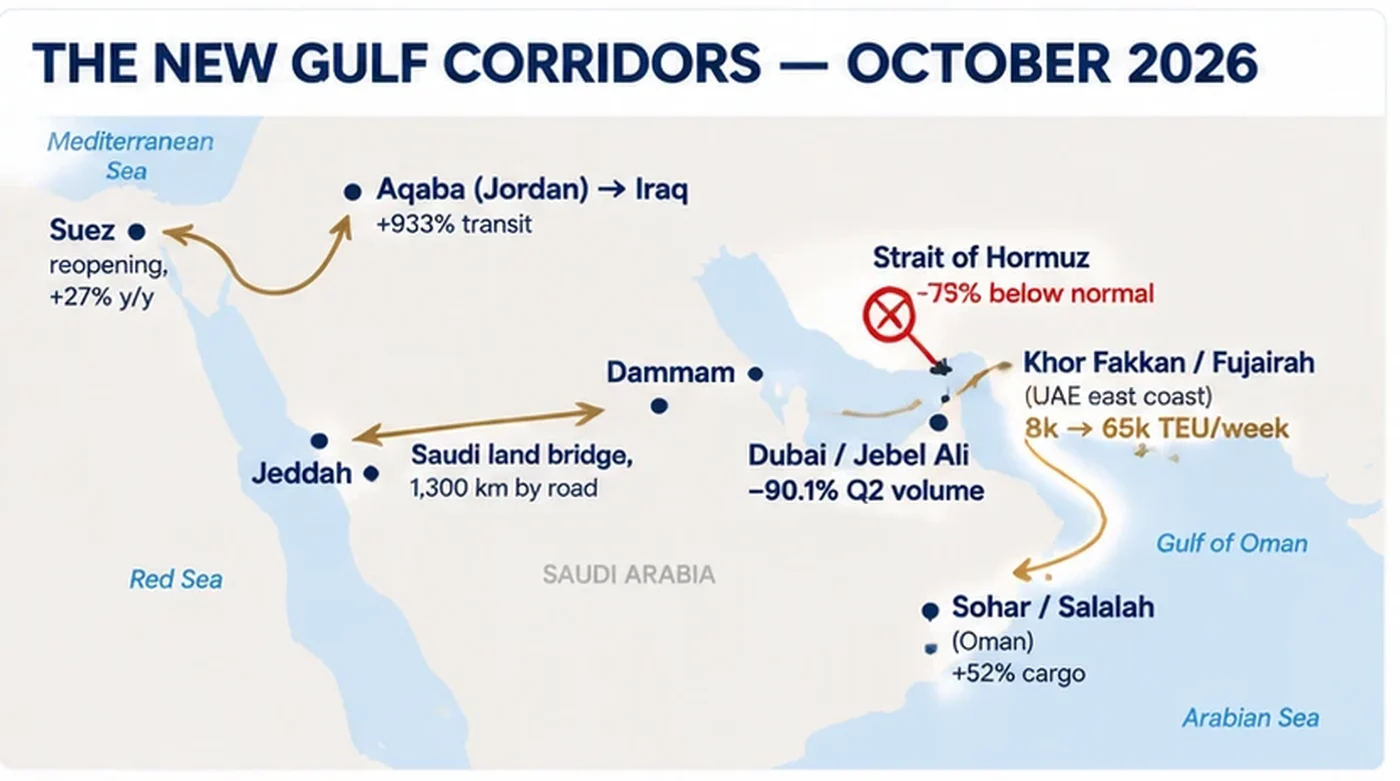
The Strait of Hormuz has been effectively closed to normal commercial traffic since the US and Israeli strikes on Iran began on 28 February. October has been the worst stretch since March. UKMTO recorded at least 12 ships attacked in the week to 16 October, one of which, the Singapore-flagged feeder GFS Pride, sank. The Joint Maritime Information Center rates the threat in the strait as severe. Iran says the strait stays shut until seven conditions are met, and Brent touched $110 on 16 October for the first time since May. Yet cargo is still reaching the Gulf and leaving it. Khor Fakkan, which handled about 8,000 containers a week before the closure, is handling about 65,000. Sohar’s cargo rose 52% in the first half. Iraq-bound transit through Aqaba is up more than ninefold. The trade has rerouted, and the new routes now set the cost, the timing and the risk of every Gulf contract.
Data as at 20 October 2026. Hormuz traffic and oil-flow figures move daily; the corridor table below carries its own status date.
Where the strait stands in October
The short version of eight months runs like this. Closure from early March, a ceasefire on 8 April and a US blockade of Iranian ports from 13 April. In May Iran created a Persian Gulf Strait Authority to charge ships for passage, formally announced on 18 May. The Islamabad memorandum of 17 June opened a 60-day negotiating window, the US ended the ceasefire on 8 July, and the blockade resumed on 14 July. The memorandum’s window ran out on 17 August. CENTCOM said on 28 August that the shipping lanes had been cleared of mines. Since late September the attacks have picked up again, on tankers, on a container feeder and, on 11 and 12 October, at the Sohar anchorage on the Omani side.
Be careful with the traffic numbers, because they are not measuring the same thing. Pre-war daily transits are given as anything from about 85 to 140 depending on who counts and which ships they include. Current traffic ranges from two or three ships a day visible on AIS to US claims of hundreds a week moving under escort with transponders off. UKMTO, combining both sources, had about 124 ships outbound and 123 inbound in the seven days to 2 October, roughly 75% below normal. Oil flows show the same spread. Kpler put the September average slightly under 9 million barrels a day through the strait, against about 17 to 20 million before the war. The US Energy Secretary said on 12 October that up to 14 million barrels a day were passing, and put the recovery at 80 to 90% of pre-war once bypass pipelines are counted. Kpler figures themselves are quoted on different bases, so always ask which one.
The east coast of the UAE became the main gate
The biggest change is that the UAE now faces the Gulf of Oman. Khor Fakkan, Gulftainer’s terminal in Sharjah, went from about 8,000 TEU a week to about 65,000 and is aiming for 100,000. A $2 billion expansion takes it to 5 million TEU a year by the end of October and to 10 million within three years. Its dry ports at Sajaa and Al Dhaid add 2.3 million TEU. Gemini, the Maersk and Hapag-Lloyd network, is relaunching its Far East to Middle East loop with Khor Fakkan as the call and Jebel Ali dropped. The first sailing left Qingdao on 17 October and is due in Khor Fakkan on 16 November. The cost comparison we published between the three UAE ports now reads very differently: the east coast is no longer the contingency option.
Jebel Ali, meanwhile, has not been damaged, but it has been bypassed. DP World reported first half volume at 3.145 million TEU, down 59.5%, and second quarter volume at 374,000 TEU, down 90.1%. Maersk now accepts dry cargo for Jebel Ali only via land bridge. Bonded trucking from Sharjah to Khor Fakkan was taking about five days in May. On 24 September Etihad Rail and AD Ports started a freight service between Fujairah and Abu Dhabi, about 200 km, three trains a week. A rail link from Khor Fakkan via Al Dhaid is planned but has no date.
Fujairah is the energy end of the same coast. The 380 km ADCOP pipeline from Habshan carries 1.5 to 1.8 million barrels a day of Abu Dhabi crude to Fujairah without touching the strait. ADNOC is targeting a second line for 2027. DP World has signed an agreement in principle with the Fujairah Ports Authority for new terminals at Al Rugaylat and Dibba. Fujairah is not safe ground. It was hit by drones on 14 and 16 March and by a barrage of missiles and drones on 4 May. We found no confirmed attack on Fujairah in September or October. Bunker sales show the cost: 227,950 cubic metres in August, down 65% on a year earlier, recovering to 236,735 in September.
Oman: the ports outside the strait, and the anchorage that is not
Sohar handled 52 million tonnes in the first half of 2026, up 52%, with 545,000 TEU of containers, up 40%, and 24.4 million tonnes of ship-to-ship transfers. Breakbulk roughly doubled. Salalah handled 2.33 million TEU, up 15%, and is now the transshipment point for much of the upper Gulf. Neither is outside the war. A crane at Salalah was damaged in a drone attack on 28 March and operations stopped for about 48 hours. The Sohar anchorage, where much of the ship-to-ship work happens, was attacked on 11 and 12 October. Maersk has also paused Sohar’s landside routes to the UAE, Saudi Arabia, Kuwait, Bahrain and Qatar. The Hafeet Rail link from Sohar to Abu Dhabi will not help this crisis: Oman’s transport minister says trial operations start in the fourth quarter of 2027.
Saudi Arabia: the pipeline, the trucks and the Houthis
Saudi Arabia has the largest bypass and the most exposed one. The East-West pipeline to Yanbu on the Red Sea has 7 million barrels a day of capacity and was running at that level by the end of March. It has been attacked twice: in April, cutting about 700,000 barrels a day until repairs, and on 10 September, when pumping stopped and Yanbu loadings halted. On 6 October the energy minister said it was back to 5.8 million barrels a day.
For containers and bulk the Saudi route is a land bridge. Since May, MSC has trucked cargo from Jeddah and King Abdullah Port about 1,300 km to Dammam and fed it on to Jebel Ali and Abu Dhabi. Fertiliser producers have done the same in reverse, moving urea and phosphate by thousands of trucks to the Red Sea — the same fertiliser complexes already squeezed by the sulphur and sulphuric acid shortage. The Saudi Landbridge railway that would make this permanent is not built. MEED reported the Riyadh section contract close to award at the end of August, with full delivery targeted for 2034.
The Red Sea side carries its own risk now. On 20 July the Houthis declared a blockade against Saudi Arabia, and on 22 July they attacked two Saudi-flagged ships. They have since attacked Saudi ports and sites ashore, including the strike on Riyadh airport on 10 October. On 29 July Lloyd’s Joint War Committee widened its Saudi listing to the whole country, Red Sea ports and coastal waters included. A Saudi port is no longer a cheap war risk option, even on the west coast.
The Red Sea and Suez: open again, for some
The Suez Canal is busier than a year ago. The Suez Canal Authority reported 1,358 transits in August, up 27% year on year, and revenue of $567.1 million. UKMTO has recorded no projectile attacks on Red Sea shipping since 24 August, and the Houthis say all ships except Saudi ones can pass. Carriers are testing it: Maersk and Hapag-Lloyd announced on 14 September that four more Gemini services would move back to Suez; three switched in September and the last, AE12, follows from 27 October. But volumes are still far from normal. Traffic through Bab el-Mandeb is still about a third of its level before October 2023, and the Houthis seized the Hanish islands and Perim in September. Government forces claim to have taken some back. For anything Saudi-linked, the Cape is still the route.
North: Aqaba, Iraq and the road to Turkey
The quietest change has been in Jordan. Aqaba’s transit containers rose 160.8% in the first seven months of 2026 to 80,235 TEU. Transit bound for Iraq rose 933% to 37,182 TEU, trucked about 760 km to the border. Maersk now routes Iraqi imports and exports through Aqaba. Iraq has also reopened the Kirkuk to Ceyhan pipeline and signed a 12-month deal with Turkey on 1 August for 750,000 barrels a day of contracted capacity. Turkish data put actual flow nearer 170,000. Fuel oil is moving by truck from Iraq to the Syrian port of Baniyas, and in early October Syria’s state oil company said Baghdad had asked for help exporting crude. Turkey’s trade minister says a Turkey-Syria-Gulf road transit corridor has operated since 15 April. We could not find published truck counts for it.
The corridors that exist mostly on paper
Every crisis brings the big corridor projects back into the headlines. Few of them move cargo today. IMEC, the India-Middle East-Europe corridor, has no construction and still depends on Saudi-Israeli normalisation for its northern rail leg. Iraq’s Development Road and Grand Faw port target a first phase in 2028. INSTC, the Russia-Iran-India route, runs through Bandar Abbas and Chabahar, both struck in this war, and is held back by banking and insurance restrictions. The Middle Corridor across the Caspian is growing: Kazakh railways counted 419 China container trains on it from January to August, up 84%. That is still nothing on the scale of a sea route.
Corridor | Status, October 2026 | What it moves | Main risk |
Hormuz direct | About 75% below normal, threat level severe | Escorted tankers, some bulk | Attacks, mines claimed, Iranian fees and sanctions |
UAE east coast (Khor Fakkan, Fujairah) | Operating, Khor Fakkan ~65k TEU/week | Containers, crude via ADCOP, bunkers | Strikes on Fujairah in March and May; port congestion |
Oman (Sohar, Salalah, Duqm) | Operating, Sohar cargo +52% in H1 | Containers, STS, breakbulk | Sohar anchorage attacked 11-12 October |
Saudi land bridge and Yanbu | Operating, pipeline back to 5.8 mb/d (6 Oct) | Crude, trucked containers, fertiliser | Houthi blockade on Saudi trade; whole country JWC-listed |
Red Sea and Suez | Reopening, Suez +27% y/y in August | Asia-Europe containers | Bab el-Mandeb islands contested; Saudi-linked cargo targeted |
Aqaba to Iraq | Operating, Iraq transit +933% Jan-Jul | Containers and grains by truck | Road capacity, border times |
Kirkuk-Ceyhan and Syria trucking | Partial, ~170k b/d actual pipeline flow | Iraqi crude and fuel oil | Low actual flow, Syrian logistics |
IMEC, Development Road, Hafeet Rail, Saudi Landbridge rail | Not operating; 2027 to 2034 | Nothing yet | Timelines and politics |
What the detour costs
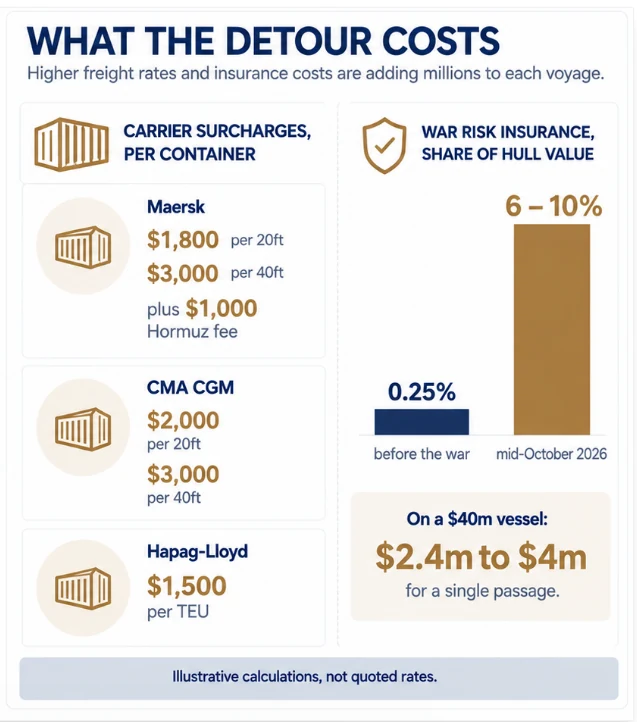
Every carrier has priced the war in. Maersk charges emergency freight of $1,800 per 20-foot box and $3,000 per 40-foot, plus a $1,000 per container Strait of Hormuz fee. On some contract bookings into the UAE it adds a $500 cost recovery surcharge. CMA CGM’s emergency conflict surcharge is $2,000 and $3,000 per box. Hapag-Lloyd’s war risk surcharge is $1,500 per TEU.
Insurance is the other half. War risk cover for a Hormuz transit was about 0.25% of hull value before the war. It went to 7.5 to 10% in late July. Brokers quoted by the FT put it at 6 to 10% in mid-October, up to $20 million for a single VLCC voyage. On a vessel insured for $40 million, a 6% premium is $2.4 million for one passage; at 10% it is $4 million. Spread over a 50,000 tonne bulk cargo, that is $48 to $80 a tonne before any freight is paid. These are our illustrations, not quoted rates. That is why so much cargo now loads on the east coast and travels by road.
The sanctions trap in safe passage
Iran has built a system to charge for passage. The Persian Gulf Strait Authority was formally announced on 18 May. A second body, the HormuzSafe Marine Services Authority, sells the fee as digital insurance and takes payment in crypto, cards and wire. A separate firm, Persian Gulf Marine Insurance Co., was sanctioned alongside it. Reported fees run up to $2 million per transit, but no official tariff has been published.
The US has sanctioned every layer of it. OFAC designated the Strait Authority on 27 May and HormuzSafe and Persian Gulf Marine Insurance on 29 July. On 17 September it added the Iranian exchange BitBank, which Treasury says moved HormuzSafe’s receipts to the regime. OFAC’s alert of 24 August is the document every Gulf trader should read. It says that paying Iranian tolls, or seeking a safe passage guarantee from Iran or any of these bodies, is a sanctions risk for US and non-US persons alike. That holds even if no payment is made, and whether the value moves in cash, crypto, swaps or so-called charitable donations. The red flags it lists include voyage plans through Iranian waters, counterparties who coordinated with Iran, and Iranian insurance accepted. A cargo that went through the strait on an Iranian permit gives the buyer’s bank a reason to refuse the documents — which is where your letter of credit stops being a formality.
What this means if you are buying
Name the port, not the region. FOB Jebel Ali and CFR Dammam now mean different things than they did in February. If the cargo will actually load at Khor Fakkan, Fujairah or Sohar, put that port in the contract, and agree who pays the land leg and the bonded trucking.
Put the war in the price clause. Agree in writing who carries carrier emergency surcharges, Hormuz fees and war risk premiums announced after signature. A CFR price with no surcharge clause is a price the seller will try to reopen.
Write the sanctions clause for this war. Require the seller to warrant that no payment, guarantee or coordination with Iranian authorities was made for the voyage. Ask for the voyage plan and AIS history, and make a breach a reason to reject documents. Under the OFAC alert, the buyer is expected to ask these questions.
Leave room in the dates. Every alternative route is longer: a land bridge adds days of trucking, Salalah transshipment adds a feeder leg, and the Cape adds two weeks. A laycan that worked in 2025 will produce demurrage in 2026.
Au Club’s offer
Au Club trades from Dubai, inside the area this article describes, and works the routes as they change. For copper cathode, metals and minerals we can quote delivery points outside the strait and write surcharges and war risk into the price clause. We document voyages for buyers’ banks and compliance teams. For marine fuel we follow supply and pricing at Fujairah and the other east coast and Omani ports weekly. Contact the desk with your product, volume and destination: AU CLUB TRADING L.L.C, Warehouse #4, 203 Umm Suqeim St, Al Quoz Industrial 4, Dubai, UAE, +971 4 262 6382, info@auclub.ae.
Looking ahead
Four things to watch. First, whether the US and Iran return to the Islamabad framework. Iran’s foreign minister says a seven-day reopening plan is on the table, and the US says Iran will not be allowed to charge tolls under any deal. Second, Khor Fakkan’s expansion and the Gemini call there from mid-November, which will show whether the east coast is a detour or the new normal. Third, the Red Sea: if the Gemini return through Suez holds as the last service switches on 27 October, Asia-Europe freight eases even with Hormuz shut. Fourth, the Saudi exposure, because the bypass with the most capacity is the one now under attack on both coasts. Until the strait reopens on terms that do not require paying Iran, the corridors are the market.
FAQs
Is the Strait of Hormuz open in October 2026?
Not to normal traffic. UKMTO put traffic about 75% below pre-war levels in early October and the Joint Maritime Information Center rates the threat as severe. Lloyd’s List Intelligence called the 13 attacks between 28 September and 12 October a seven-month high.
How is cargo reaching the UAE without Hormuz?
Mostly through Khor Fakkan and Fujairah, the east coast ports on the Gulf of Oman. From there it moves by bonded truck or the new Etihad Rail freight service to Abu Dhabi. Khor Fakkan went from about 8,000 to about 65,000 TEU a week. Some cargo also arrives via Sohar and Salalah in Oman, and via Jeddah with trucking across Saudi Arabia.
What is the Saudi land bridge?
Trucking cargo about 1,300 km between Jeddah or King Abdullah Port on the Red Sea and Dammam on the Gulf, then feeder ships to the UAE. MSC started it in May 2026. The Saudi Landbridge railway that would replace the trucks is targeted for 2034.
Can a ship pay Iran for safe passage through Hormuz?
Doing so exposes the payer and its counterparties to US sanctions. OFAC designated the Persian Gulf Strait Authority, HormuzSafe Marine Services Authority and Persian Gulf Marine Insurance Co. Its 24 August alert says even seeking a safe passage guarantee from Iran is a sanctions risk, with or without a payment.
How much does war risk insurance cost in the Gulf now?
For a Hormuz transit, brokers quoted by the FT put it at 6 to 10% of hull value in mid-October, against about 0.25% before the war. On a $40 million vessel that is $2.4 million to $4 million for a single passage.
Is the Red Sea safe again for shipping?
Safer than in 2024 and 2025 for most ships. UKMTO has recorded no projectile attacks on Red Sea shipping since 24 August, and Suez transits were up 27% year on year in August. But the Houthis are blockading Saudi trade, and Lloyd’s Joint War Committee now lists all Saudi ports and coastal waters.
About Au Club
Au Club is a Dubai-based commodity trading company supplying marine fuel, metals, and minerals worldwide. We trade copper cathode, antimony, tungsten, molybdenum oxide, tin concentrate and fly ash, with independent inspection, full documentation and benchmark-referenced pricing, FOB UAE or CFR/CIF destination. Our desk is at Warehouse #4, 203 Umm Suqeim St, Al Quoz Industrial 4, Dubai, UAE. To enquire about availability and pricing, call +971 4 262 6382 or email info@auclub.ae.
Sources & further reading
- UKMTO — Voluntary Reporting Area weekly overview No. 9 (2 Oct 2026)
- Al Jazeera — Hormuz attacks and oil flows (14 and 17 Oct 2026); US says flows recover to 14 million bpd (12 Oct 2026)
- The National — Iran’s conditions for reopening (4 Oct 2026); Khor Fakkan capacity to double (7 Jul 2026)
- The Loadstar — Gemini relaunches the Asia-Middle East loop and drops Jebel Ali (13 Oct 2026)
- DP World — first half 2026 results (13 Aug 2026)
- Muscat Daily — Sohar Port H1 2026 cargo volumes (19 Aug 2026)
- MEED — contract award nears for the Saudi Landbridge Riyadh section (31 Aug 2026)
- Lloyd’s Market Association — JWLA-034 Saudi Arabia listing (29 Jul 2026)
- Ahram Online — Suez Canal August traffic and revenue (20 Sep 2026); Gemini services return to Suez
- Jordan News — transit traffic via Aqaba up 160% in seven months (11 Aug 2026)
- OFAC — sanctions risks of Iranian demands for Strait of Hormuz passage (alert updated 24 Aug 2026); recent actions (29 Jul 2026); Treasury press release on BitBank (17 Sep 2026)
- Maritime Executive — US sanctions two insurers over Hormuz transit fees (29 Jul 2026)
- Lloyd’s List Intelligence — Strait of Hormuz brief (12 Oct 2026)