China’s Export-Control Pause: 10 November, 10 January, or Neither?
China's export-control pause was due to end on 10 November. What was suspended, what never was, and what it means for antimony, tungsten and rare earths.

In a nutshell
- China’s suspension of its October 2025 export controls is legally due to end on 10 November 2026.
- Washington and Beijing say the truce now runs to 10 January 2027, but Beijing has not yet published the legal text.
- Tungsten, molybdenum, antimony, gallium, germanium and seven rare earths were never part of the pause. They need a Chinese export licence either way.
- The two-price market stays: Rotterdam tungsten APT is about 3.5 times China’s domestic price.
- For buyers: make delivery conditional on the export licence, and treat 10 November as live until MOFCOM says otherwise.
For a year the critical minerals market has had a date circled: 10 November 2026, when China’s suspension of its October 2025 export controls was set to run out. On 23 September US Treasury Secretary Scott Bessent said the truce would now hold until 10 January 2027. On 28 September China’s Ministry of Commerce confirmed the same date for what it called the Kuala Lumpur joint arrangement. That sounds settled. It is not quite. As of 20 October MOFCOM has not reissued Announcement No. 70 of 2025, the document that actually suspends the controls, with a new end date, and its readout did not mention rare earths or export controls by name. Meanwhile the controls that matter most for tungsten, molybdenum, antimony, gallium, germanium and the heavy rare earths were never part of the pause. The price gap between China and everyone else says the market has already worked that out.
Data as at 20 October 2026. This article is time-sensitive: if MOFCOM gazettes a new date, the dated tables below are what changes first.
What was suspended, and until when
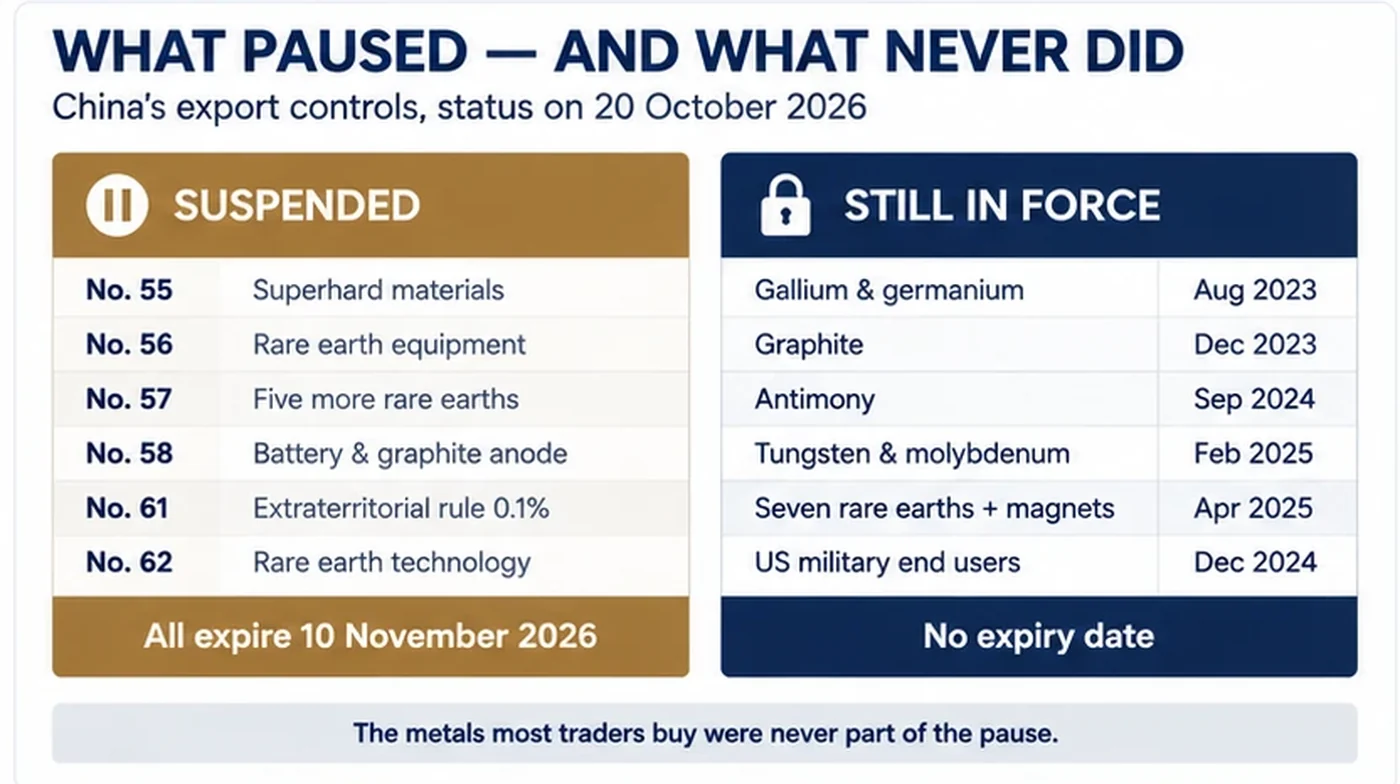
On 9 October 2025 China published six export-control announcements that went further than anything before them: five more rare earths, rare earth equipment and technology, lithium battery and graphite anode materials, superhard materials, and an extraterritorial rule that reached foreign-made goods containing Chinese rare earths. A month later, after the Trump-Xi meeting in Busan on 30 October, Beijing put all six on hold. Announcement No. 70, signed on 7 November 2025, suspends them until 10 November 2026. Announcement No. 72, signed two days later, separately suspends until 27 November 2026 the clause of Announcement No. 46 of 2024 that banned exports of gallium, germanium, antimony and superhard materials to the United States.
Measure | What it covers | Status on 20 October 2026 |
MOFCOM/GAC No. 55 of 2025 | Superhard materials: synthetic diamond powders, wire saws, grinding wheels, DC-PCVD equipment | Suspended to 10 Nov 2026 (No. 70) |
MOFCOM/GAC No. 56 of 2025 | Rare earth production equipment, ores, reagents and extractants | Suspended to 10 Nov 2026 (No. 70) |
MOFCOM/GAC No. 57 of 2025 | Five more rare earths: holmium, erbium, thulium, europium, ytterbium, with alloys, oxides and compounds | Suspended to 10 Nov 2026 (No. 70) |
MOFCOM/GAC No. 58 of 2025 | Lithium-ion batteries, cathode materials, artificial graphite anode, equipment and technology | Suspended to 10 Nov 2026 (No. 70) |
MOFCOM No. 61 of 2025 | Extraterritorial rule on foreign items with Chinese rare earth content, 0.1% de minimis | Suspended to 10 Nov 2026 (No. 70) |
MOFCOM No. 62 of 2025 | Rare earth mining, separation, magnet and recycling technology | Suspended to 10 Nov 2026 (No. 70) |
No. 46 of 2024, Article 2 | Ban on gallium, germanium, antimony and superhard material exports to the US; stricter graphite end-use review | Suspended to 27 Nov 2026 (No. 72) |
The US gave things in return, and those have their own dates. The Commerce Department’s Affiliates Rule, which would have extended Entity List restrictions to companies 50% owned by listed parties, was suspended by Federal Register notice to 9 November 2026. The Section 301 port fees on China-linked ships, and China’s counter fees, were suspended for a year from 10 November 2025. The fentanyl tariff cut that headlined the Busan deal no longer exists in any form: the US Supreme Court struck down all IEEPA tariffs on 20 February 2026.
The extension that has not been written down yet
The eighth round of US-China talks opened in New York on 20 September, ahead of Xi Jinping’s state visit. Bessent said afterwards that the truce conditions stay in effect until 10 January 2027. On 28 September an official of MOFCOM’s Americas and Oceania department gave Beijing’s version. The Kuala Lumpur arrangement, which suspended certain tariff and non-tariff measures until 10 November, would be extended to 10 January, and both sides would keep working on a solution before year end.
Three things are missing. MOFCOM has published no new announcement amending No. 70 or No. 72. The readout did not use the words rare earths or export controls. And no source we can find addresses whether the January date also covers the separate 27 November date for the gallium, germanium and antimony ban. On the US side, Commerce has not published a Federal Register notice moving the Affiliates Rule either. Analysts are split on how to read this. Some take the 28 September statement as covering the export-control pause, others note that Beijing has deliberately kept rare earths out of the wording. Both readings are reasonable. Neither is law yet.
The White House fact sheet from the state visit says the two sides continue to work on rare earth shortages. The stated goal is returning shipments to appropriate levels. Read plainly, that is Washington saying shipments are not yet where it wants them. Beijing, for its part, told the EU on 9 October that it will keep fast-tracking rare earth and magnet licences through its existing channel. MOFCOM’s spokesman repeated on 15 October that China is willing to keep facilitating rare earth licence approvals for the EU. Neither statement removes a single control. Both describe a licence system that China intends to keep and manage.
What never paused
This is the part most coverage skips. The suspension only covers the October 2025 package and the US-specific clause of No. 46. Every earlier licence regime stays exactly where it was, and those are the ones that set the price for most of the metals traders deal in — as we set out when tungsten and molybdenum were first added to the list in February 2025.
Measure | Products | In force since |
MOFCOM/GAC No. 23 of 2023 | Gallium and germanium items, licence required | 1 August 2023 |
MOFCOM/GAC graphite announcement of October 2023 | Spheroidised and high-purity graphite | 1 December 2023 |
MOFCOM/GAC No. 33 of 2024 | Antimony ores, unwrought metal, oxides and compounds | 15 September 2024 |
No. 46 of 2024, Article 1 | All dual-use exports to US military users and end uses banned | 3 December 2024 |
MOFCOM/GAC No. 10 of 2025 | Tungsten, molybdenum, tellurium, bismuth and indium items | 4 February 2025 |
MOFCOM/GAC No. 18 of 2025 | Seven rare earths: samarium, gadolinium, terbium, dysprosium, lutetium, scandium, yttrium, plus magnets | 4 April 2025 |
MOFCOM No. 1 of 2026 | Dual-use exports to Japanese military end users | 6 January 2026 |
Since then China has mostly added companies rather than minerals. Announcement No. 23 of 22 June 2026 put ten US firms, among them MP Materials, USA Rare Earth and L3Harris Maritime Services, under a full dual-use export ban. Silver exports are limited to 44 state-approved companies for 2026 and 2027, and tungsten and antimony exports run through similar state-trading lists. None of this expires in November or January. A buyer of tungsten concentrate, molybdenum oxide or antimony ingot from China needs an export licence today and will need one in February whichever way the date question is settled.
The two-price market, in numbers
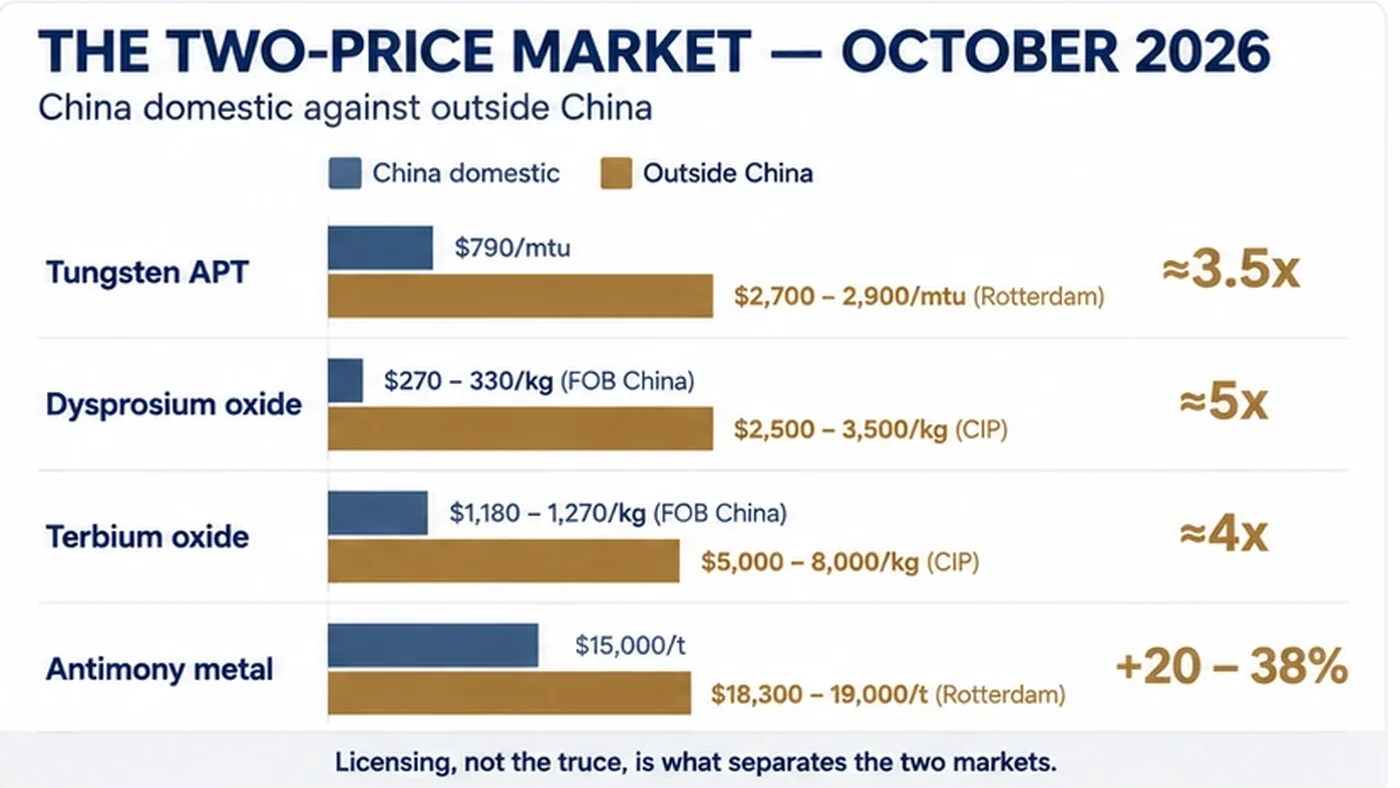
If the pause were the thing holding prices down, Chinese and Western prices would be converging as the truce holds. They are not. Licensing is the wall, and the price gap sits on top of it.
Product | China domestic | Outside China | Gap |
Tungsten APT | 470,000 yuan/t (SMM, 15 Oct), about $790/mtu | $2,700-2,900/mtu Rotterdam (Fastmarkets, 2 Oct); $2,775 (SP Angel, 20 Oct) | About 3.5x |
Antimony metal | 92,000 yuan/t #1 ingot (SMM, 16 Oct); 100,000-103,000 yuan, $14,943-15,392 (Fastmarkets, 9 Oct) | $18,300-19,000/t in-whs Rotterdam (Fastmarkets, 14 Oct) | Roughly 20-38% |
Dysprosium oxide | $270-330/kg FOB China (Fastmarkets, 27 Aug) | $1,250-1,675/kg Rotterdam (27 Aug); $2,500-3,500/kg CIP (1 Oct) | About 5x in August, wider since |
Terbium oxide | $1,180-1,270/kg FOB China (Fastmarkets, 27 Aug) | $4,200-5,000/kg Rotterdam (27 Aug); $5,000-8,000/kg CIP (1 Oct) | About 4x in August, wider since |
Molybdenum oxide 57% | Not available for October | $33.1-33.4/lb Mo Asia (SMM, 1-7 Oct); $33.0/lb Europe (SP Angel, 20 Oct) | n/a |
Two notes on method. The tungsten conversion takes 470,000 yuan a tonne of APT and divides by the 88.5 metric ton units of WO3 in a tonne. That gives about 5,311 yuan per mtu, or about $790 at the roughly 6.70 yuan per dollar implied by Fastmarkets’ own conversions this month. Chinese domestic prices generally include 13% VAT, so stripping it out widens every gap in the table. These are our calculations, not published spreads.
Antimony: the cliff that already fell
Antimony is the clearest case of a market that stopped waiting for Beijing. European metal peaked at about $59,750 a tonne in June and July 2025, after China put antimony under licence in September 2024. Fastmarkets now has Rotterdam at $18,300 to $19,000, flat since 4 September, which is roughly 69% below that peak. United States Antimony’s realised price fell from $28.32 a pound in the second quarter of 2025 to $13.70 a year later. Its chief executive expects about $10 a pound for the rest of 2026. That is the other side of the re-rating we described in Antimony 18 Months On.
The pause had little to do with it. High prices brought new smelting capacity in Southeast Asia and more Tajik supply, flame-retardant buyers cut usage or substituted, and European warehouses filled. Smelters have pushed concentrate payables down, with one Fastmarkets source citing a move from about 70% to 55%. Inside China, SMM has the #1 ingot price down 12.4% in the week to 16 October. Its reading of customs data shows ore imports up 92% month on month in September, to 8,435 tonnes. The 27 November date matters for one narrow flow, Chinese antimony to US buyers. For everyone else the licence regime of 2024 is the rule, and the market has repriced around it.
Tungsten: China cracked, the West did not
Tungsten shows the split from the other direction. Chinese APT went through a speculative run early this year and broke a million yuan a tonne. SMM now puts it at 470,000 yuan, about 69% below its mid-March high and back where it started the year. Wolframite concentrate is down 71.3% from the same peak. In Rotterdam, APT is still $2,700 to $2,900 per mtu, more than four times where it was in October 2025, when it was $580 to $615.
The reason the gap holds is that the cheap Chinese units cannot leave freely. Even the FOB China export quote, which SP Angel had at $1,835 per mtu on 20 October, is about 1.5 times the domestic price and still well below Rotterdam. China’s exports of dual-use tungsten intermediates were about 9,071 tonnes in January to August, down roughly 15% on the year. SMM expects only uncontrolled items such as ordinary carbide inserts and powder to grow. On the demand side, the US defence procurement clause DFARS 252.225-7052 tightens on 1 January 2027. It already bars contractors from delivering tungsten metal powder, tungsten heavy alloy, tantalum and rare earth magnets melted or produced in China, Russia, North Korea or Iran. From January it also catches material mined, refined or separated there. That is a procurement rule, not an import ban, but it puts a floor under demand for documented non-Chinese tungsten. It is also why tungsten carbide scrap, which comes back into the chain outside Chinese licensing, now trades as a strategic feed and not a by-product.
Rare earths: the part that really is on the clock
Rare earths are where the November and January dates do bite, because two of the suspended measures are specific to them. If No. 57 comes back, holmium, erbium, thulium, europium and ytterbium join the seven elements already licensed. If No. 61 comes back, foreign magnet and component makers using Chinese material above the 0.1% threshold need Chinese permission to re-export. That is a compliance problem for every downstream buyer in Europe, Japan and the Gulf.
The market is pricing that risk. Fastmarkets’ global CIP terbium oxide price jumped 41% in a week to $5,000 to $8,000 a kilo on 1 October, and dysprosium oxide rose to $2,500 to $3,500 a kilo. At the same time Chinese magnet exports reached 6,165 tonnes in September, up 23% on the month and the highest this year. Both things are true at once: China is shipping more, and buyers outside China are paying more for anything that does not depend on a Chinese licence. Japan is the cautionary example. Customs data show no dysprosium or terbium oxide exported from China to Japan since November 2025, and Fastmarkets reports none at all this year. The WSJ reported in January that Beijing had stopped reviewing heavy rare earth licence applications from Japanese companies, without any formal announcement.
Molybdenum: never part of the deal
Molybdenum has been under licence since February 2025 under Announcement No. 10, together with tungsten, and nothing in the 2025 truce touched it. Western oxide is trading around $33 a pound of contained molybdenum. SMM had $33.1 to $33.4 in Asia for early October, and SP Angel had $33.0 in Europe on 20 October. For moly buyers the expiry date is close to a non-event. The live questions are the same as last year. Licence timing on Chinese material, assay and payable terms on roasted concentrate, and how much non-Chinese oxide can be contracted for 2027.
Three scenarios for 10 November
Scenario | What happens | Who feels it |
Quiet extension | MOFCOM reissues No. 70 and No. 72 with 10 January 2027, or simply lets officials’ statements stand and enforces nothing new | Little change. The two-price market stays because the older licence regimes stay |
Selective reinstatement | Some measures return, most likely the technology and equipment controls (No. 56, No. 62) or the extraterritorial rule (No. 61), while minerals keep flowing under licence | Magnet makers, Western rare earth refiners and recyclers, component exporters re-selling into the US |
Full snapback | All six October 2025 measures return on 11 November and the US-specific ban returns on 28 November | Heavy rare earth and magnet buyers first; gallium, germanium and antimony buyers in the US; a jump in ex-China premiums |
Our reading is that the first scenario is the most likely in the short run, because both governments have said so publicly and the next leaders’ meetings, APEC in Shenzhen in November and the G20 in Miami in December, give each side a reason to keep the date alive. But the absence of a gazetted text is not a technicality. It leaves Beijing able to let the old date stand without breaking any written promise. Anyone writing a contract this month should treat 10 November as live until MOFCOM says otherwise.
What this means if you are buying
Contract around the licence, not the headline date. For any Chinese-origin material in the controlled lists, make delivery conditional on the export licence being granted. Set a long-stop date, and agree in writing who carries the cost if it is refused. Do not let a supplier put licence refusal under general force majeure without a time limit.
Price on the market you are actually in. A Chinese domestic quote converted into dollars is not a delivered price for a buyer outside China. Ask whether the offer is for material that already has an export licence, and for how much tonnage. For tungsten and rare earths, a seller quoting near Chinese domestic levels for export is either holding a licence or telling you a story. It is fair to ask which.
Get origin and chain-of-custody documents now if you sell anywhere near US defence supply chains. The tighter DFARS rule applies from 1 January 2027 whatever happens in November, and contractors will be asking their suppliers where the tungsten in their parts was mined and refined. Material that can show a non-Chinese route, including recycled carbide, will command the premium. Our 2026 country-risk map sets out how the alternative origins compare.
Au Club’s offer
Au Club trades antimony ingots and concentrate, tungsten concentrate and tungsten scrap, and molybdenum oxide from our desk in Dubai, with independent inspection, documented origin and full shipping documentation. We can talk through origin options, licence exposure and contract structure for fourth quarter and 2027 volumes, including what the November and January dates mean for a specific purchase.
Looking ahead
Five dates decide this. 10 November, the legal expiry on the published text of No. 70. 15 November, the end of comments on MOFCOM and the science ministry’s proposal of 16 October to add 40 AI, biopharma and solar technologies to China’s restricted export catalogue — the control system is still growing in other areas. 27 November, the expiry of the pause on the US-specific gallium, germanium and antimony ban. 1 January 2027, when the DFARS restrictions extend to where the material was mined and refined. And 10 January 2027, the date both governments now say the truce runs to. Watch MOFCOM’s announcement page, not the press conferences. Until a new number appears there, the November dates are still the law.
FAQs
Do China’s rare earth export controls come back on 10 November 2026?
Not necessarily. The published text of MOFCOM Announcement No. 70 suspends the October 2025 controls until 10 November 2026. Both governments said in late September that the truce now runs to 10 January 2027, but as of 20 October MOFCOM had not published a new announcement changing the date.
What did China suspend in November 2025?
Six announcements from 9 October 2025: Nos. 55, 56, 57, 58, 61 and 62, covering superhard materials, rare earth equipment, five more rare earths, lithium battery and graphite anode materials, an extraterritorial rule and rare earth technology. Separately, Announcement No. 72 suspended the ban on gallium, germanium and antimony exports to the US until 27 November 2026.
Are tungsten and molybdenum exports from China affected by the suspension?
No. Tungsten and molybdenum have been under export licence since 4 February 2025 under Announcement No. 10, and that regime was never suspended. Antimony (since September 2024), gallium and germanium (since August 2023) and the seven rare earths of April 2025 also stay licensed.
Why is tungsten so much cheaper in China than in Rotterdam?
Because the export licence separates the two markets. Chinese APT was 470,000 yuan a tonne on 15 October, about $790 per mtu, while Rotterdam APT was $2,700 to $2,900 per mtu. Cheap domestic units cannot be exported freely, so the gap does not close.
Why has the antimony price fallen so far?
Western antimony is down roughly 69% from its mid-2025 peak, to $18,300 to $19,000 a tonne in Rotterdam. New smelting capacity outside China, extra supply from Tajikistan and buyer substitution caught up with the 2024 controls. The November suspension expiry only affects Chinese antimony sold to US buyers.
Can Au Club supply antimony, tungsten or molybdenum outside the Chinese licence system?
We trade antimony ingots and concentrate, tungsten concentrate and scrap, and molybdenum oxide with documented origin and independent inspection. Contact the desk with your specification and volume and we will set out the origin options and licence exposure for that purchase.
About Au Club
Au Club is a Dubai-based commodity trading company supplying marine fuel, metals, and minerals worldwide. We trade antimony, tungsten, molybdenum oxide, tin and copper cathode with independent inspection, full documentation and benchmark-referenced pricing. To enquire about availability and pricing, contact our trading desk.
Sources & further reading
- MOFCOM/GAC Announcements No. 70 (7 Nov 2025) and No. 72 (9 Nov 2025), via the Hong Kong Trade and Industry Department
- Pillsbury — China suspends export controls on certain critical minerals and related items (Nov 2025)
- Fastmarkets — gallium, germanium and antimony suspension; Europe’s antimony market (15 Oct 2026); tungsten market outlook (9 Oct 2026)
- Federal Register 2025-19846 — one-year suspension of the Affiliates Rule
- Steptoe — US Supreme Court strikes down IEEPA tariffs (20 Feb 2026)
- CSIS — takeaways from the Trump-Xi summit (28 Sep 2026); White House state-visit fact sheet
- SMM — antimony, tungsten and molybdenum market reviews (16-19 Oct 2026); China rare earth magnet exports (20 Oct 2026)
- Baker McKenzie — China proposes expanded export controls on AI, biopharma and solar technologies (18 Oct 2026)
- Benchmark Mineral Intelligence — implications of China’s rare earth restrictions on Japan (13 Jan 2026)
- DFARS 252.225-7052 — restriction on the acquisition of certain magnets, tantalum and tungsten